Drought and Water Costs When Buying a Home in Arizona
Buying a home in Arizona means looking beyond the kitchen tap and asking two practical questions: how dependable is the water supply, and what will water-related costs look like over time? Drought does not affect every neighborhood the same way. This guide explains what to check in utility records, bills, water plans and property documents before you commit.
How drought can affect a home’s water supply
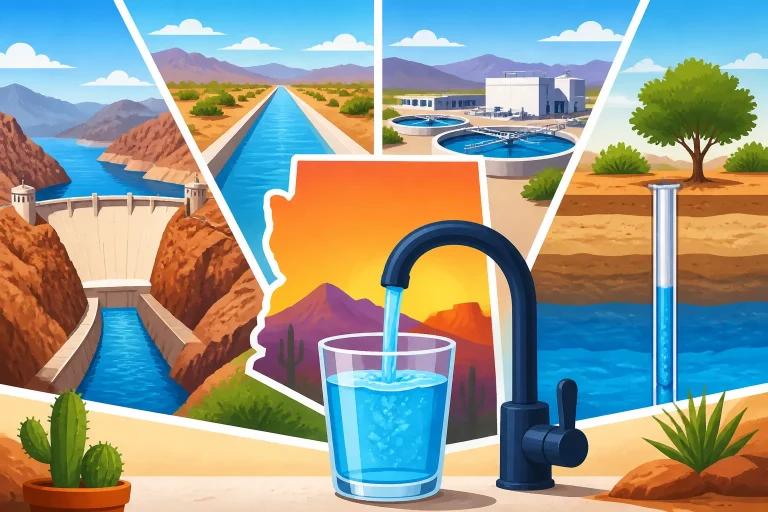
Arizona homes draw water from different combinations of sources. A city or water company may use Colorado River water delivered through the Central Arizona Project, Salt and Verde River water, groundwater, or a blend. Some providers also use recovered or stored water. The mix depends on the provider and can vary by service area.
That matters because drought pressure is not distributed evenly. A river shortage can affect a provider that relies heavily on a particular river supply differently from one with more groundwater, storage, or other sources. A change in source mix may also affect taste, hardness or other characteristics at the tap without meaning the water is unsafe. For background, see CAP, SRP, Groundwater or a Blend: Where Arizona Tap Water Comes From and Drought, River Shortages and the Water at Your Arizona Tap.
Drought is a long-term supply concern, not a prediction that a specific home will run out of water. Public water providers plan for supply disruptions and may use conservation measures, additional sources, storage, or other operational strategies. However, a plan is not a guarantee that drought will have no effect on rates, construction, or future restrictions. A home in a city system and a home served by a private well can face very different risks.
Before buying, identify the actual water provider for the property. A nearby city name or mailing address does not always tell you which utility serves the lot. Subdivisions can have a private water company, a special district, or a small system, and adjoining homes may have different providers. Start with the seller’s utility bill, then confirm the service address with the provider. Which Utility’s Water Quality Report Covers Your Arizona Address? explains why confirming the provider matters when reviewing water records.
Ask about supply, not just drought headlines
A statewide drought map or news report can provide context, but it cannot show how a particular provider manages its supply. Look for the provider’s water resource, drought, conservation or supply plan. Depending on the provider, these documents may describe its sources, backup arrangements, demand forecasts, conservation measures, drought stages and actions that could follow a shortage.
Ask the provider or seller:
- What sources currently serve the property’s system or service area?
- Does the provider expect to change its source mix or pursue new infrastructure?
- What drought stages or conservation measures are in effect, if any?
- Could restrictions apply to outdoor use, new connections, or development?
- Where can customers find current supply updates and alerts?
- Is the property’s service connection active, or would a new connection be needed?
Some answers may require checking more than one document or department. A water plan describes planning assumptions and commitments; it does not necessarily tell you exactly what will happen to an individual customer’s bill or service during a future shortage. Ask the provider to clarify how its plan applies to the property’s service area.
A supply plan is not the same as a guarantee
A provider may have a plan for meeting future demand, but the document’s status and meaning matter. Arizona uses terms such as assured water supply and adequate water supply in particular regulatory contexts. These are not interchangeable with a general statement that a neighborhood has water service.
For a home in a new or recently developed subdivision, ask what water-supply determination applies to the development and whether it covers the specific lots being sold. The rules depend on the location and development type. Assured and Adequate Water Supply Rules: An Arizona Home Buyer’s Guide explains the distinction and points to questions buyers can raise.
A long-established home already connected to a public system is a different situation from an undeveloped lot awaiting a new connection. Even so, check whether the seller’s service is active, whether there are outstanding connection requirements, and whether the provider has disclosed any limitations. If the property is part of a new phase or a planned community, verify that the home’s service is included rather than assuming that nearby water infrastructure guarantees a connection.
What water will cost after closing
Water costs are not just the amount of water used. A monthly bill can include a fixed service charge, a usage charge, sewer service, taxes or other utility charges. The structure varies by provider, so a neighbor’s bill, a listing’s estimate or a seller’s recent bill may not predict your future costs.
A low-use month can still produce a sizable bill if fixed charges are a meaningful part of the total. Conversely, a household with higher outdoor use may pay much more under a rate structure that charges more as use rises. The key is to get the provider’s current rate schedule and understand what each line item covers.
| Cost item | What to check | Why it matters to a buyer |
|---|---|---|
| Fixed water charge | Whether it applies even with little or no use, and whether meter size affects it | Sets a baseline cost before consumption |
| Water usage charge | Billing units, tiers, seasonal rates, and how usage is read | Larger households or outdoor use may raise the bill |
| Sewer charge | How it is calculated and whether a seasonal or winter-use method applies | Sewer costs may not track the current month’s water use |
| Connection or account charges | Whether the property is already connected and in good standing | A vacant lot or inactive service may have additional steps |
| Irrigation water | Whether the property has a separate meter or provider | Landscaping costs may not appear on the indoor water bill |
| Private well expenses | Electricity, testing, repairs, treatment and replacement parts | A well does not mean water is free |
| Septic expenses | Inspection, pumping, repair or replacement needs | These costs are separate from a city sewer bill |
| HOA or community charges | Whether water or irrigation is included in dues | Shared costs can obscure actual household consumption |
Review a full billing history
Ask the seller for a year or more of water and sewer bills if available. Use the bills as a starting point, not as a forecast. An unoccupied home, a recent leak, a pool fill, a landscape installation, or a change in household size can make past use unrepresentative.
Compare bills across seasons and look for both consumption and charges. Confirm the billing period and unit of measurement, then check whether the provider uses a fixed charge, a tiered rate, or another formula. A bill can rise because of higher use, a rate change, a meter adjustment, a leak, or a new fee. Understanding Your Arizona Water Bill: Charges, Help and Disputes offers a useful overview of how to separate those possibilities.
Ask whether the seller has had a leak adjustment, meter issue, late charge, or billing dispute. If a recent bill is unusually high, do not assume the amount reflects normal use. Ask the provider how to confirm the meter reading and whether any adjustment or payment arrangement is still pending. The buyer should also confirm which charges, if any, remain attached to the account or property under the provider’s procedures.
Sewer charges can be a surprise
A combined water and sewer bill can make it difficult to tell which service is driving the total. Some providers calculate sewer charges using a seasonal usage period, a fixed rate, or another method rather than using the same month’s water consumption. A large outdoor watering season or pool fill may affect sewer calculations differently depending on the provider’s rules.
Ask the provider how sewer charges are calculated and whether the property has a separate irrigation meter or a sewer adjustment process. If a home has a pool, extensive landscaping, or seasonal occupancy, those details can make past bills especially hard to interpret. See How Arizona Cities Calculate Water and Sewer Charges on One Bill for more on reading combined charges.
Future costs may reflect infrastructure and supply decisions
Water rates can change when a provider needs to operate new treatment or pumping facilities, replace aging pipes, expand service, or pay for other infrastructure. Drought can add pressure to planning and supply costs, but it is rarely useful to assume that every drought-related expense will appear in a particular way on a household bill. Providers set rates under their own processes, and costs differ by system.
Check the provider’s public rate information and any customer notices about proposed changes. If the property is served by a private water company or small district, review its service terms and recent customer communications as well as its rate schedule. For a broader look at the forces behind bills, read What Is Driving Arizona Water Rate Increases, and Will They Continue?.
Check the property’s water arrangements before you make an offer
The first due-diligence step is to establish how water reaches the property. A home may have a direct connection to a city or private water system, a shared well, an individual private well, or a less common arrangement involving hauled water and storage. Do not rely only on a real estate listing description. Confirm the setup through property records, seller disclosures, provider documents, and an inspection appropriate to the system.
For a home on a public water system
Confirm the provider, service status, meter location, account balance process, and whether the property is connected to the system. Ask if the meter is accessible and whether the provider has reported leaks, outages, service restrictions, or planned work in the area. If the home is not currently connected, ask about connection requirements and costs directly with the provider.
Then find the provider’s water quality report and determine which system or service area applies. A report can help you understand system-level monitoring, but it cannot establish the condition of the plumbing inside a particular house. Arizona Tap Water: A Homeowner’s Guide to Sources, Safety and Reports covers the difference between system information and the water at an individual faucet.
If the home is older, ask about the service line and indoor plumbing materials. A provider’s inventory may cover the public portion of a service line but not all plumbing on the property. Who Owns the Pipe? Meter, Service Line and Homeowner Duties in Arizona explains why it is useful to clarify ownership and responsibility before arranging repairs or testing.
For a property on a private well
A private well shifts more responsibility to the owner. You need to understand the well’s condition, production, equipment, testing history, and any treatment system, as well as how the water is stored and delivered to the house. A water test is important, but it does not show whether the well can reliably meet household demand. That requires a separate assessment of the well and its equipment.
Request the well’s records, test results, repair history, pump information, and any available production or water-level information. Have an appropriately qualified professional inspect the well and associated equipment, and arrange current water testing through a suitable lab. Ask which tests are appropriate for the local geology, well history and nearby land uses rather than ordering only a generic panel. Private Wells in Arizona: A Homeowner’s Guide to Ownership and Upkeep and Testing Arizona Well Water: Schedules, Labs and Reading Results cover the owner’s responsibilities and testing considerations.
A well’s depth is not proof that it will always produce enough water. Well performance can change, and a seller’s past experience does not guarantee future supply. If the home has treatment equipment, ask for its service history and confirm what it is designed to reduce. Do not assume that an existing filter or softener addresses every concern or is still functioning properly. A current lab result should guide any treatment decisions.
For a shared well
A shared well adds a legal and practical layer. Obtain the recorded agreement and read it carefully. It should clarify who owns the well and equipment, how costs are divided, who handles maintenance, how repairs are approved, what happens if a participant does not pay, and whether access is protected.
Confirm that the agreement covers the property being purchased, not merely a neighboring parcel or a prior owner’s arrangement. Ask for maintenance and repair records, current water tests, and information on the well’s capacity and reliability. If the agreement is vague or missing, get legal advice before relying on informal promises. Private Well or Shared Well? The Difference for Arizona Buyers and What a Shared Well Agreement Should Spell Out for Arizona Co-Owners explain issues to examine.
For hauled water and storage tanks
Some rural properties use water hauled to a storage tank. In that case, the buyer should understand the water source, delivery arrangement, storage capacity, tank condition, refill logistics, and any treatment or disinfection practices. Ask who supplies the water and what documentation is available about its quality. Inspect the tank, plumbing, pumps and alarms, and plan for the cost and timing of deliveries.
A stored supply can be vulnerable to equipment failure, contamination, or a missed delivery. A water tank’s capacity alone does not tell you how long it will last; household demand, irrigation, leaks and delivery access all matter. Make sure the property’s setup is suited to the intended use and that the seller can document how it has been operated.
Understand Arizona’s water rules and the limits of a map
Arizona’s water management system differs by location and water source. Active Management Areas and Irrigation Non-Expansion Areas have distinct groundwater rules, while areas outside them are subject to a different regulatory framework. The location of a property can affect well drilling, groundwater use, development planning and other water-related questions. Arizona Groundwater Law: AMAs, INAs and the Rules Beyond Them provides context on these geographic distinctions.
A property’s presence inside or outside a particular management area does not, by itself, tell you whether the home has a reliable supply or what it will cost. It is one piece of due diligence. Confirm the provider or well arrangement, the applicable water documentation, and the rules that apply to the intended use of the property.
New lots and planned developments need extra verification
When buying a new home, a vacant lot, or a property in a development that is still being built out, verify the water supply for the specific development and lot. Ask for the applicable supply determination, the identity of the provider, connection status, and any conditions that affect service. If the seller or builder describes the supply as assured, ask what document supports that statement and which lots it covers.
Do not treat a nearby water main as proof that a property is entitled to service. A main may be close but a connection may still require approvals, extensions, capacity, or payment. Similarly, an old well record does not automatically establish that a well is active, properly constructed, or capable of meeting current needs.
Drought plans and local restrictions
Drought planning can involve different agencies and local providers, and the details can change. A statewide drought status does not automatically impose the same household restrictions everywhere. Cities, districts, and other providers may have their own conservation stages, ordinances, or customer rules.
Before closing, check the city or provider’s current notices and the applicable local rules for outdoor watering, pools, landscape installation, or other high-use activities. If the home has an HOA, ask about landscape standards, irrigation schedules, and any community rules. Also check whether a drought stage is already active and what the provider says it means for customers. Finding the Outdoor Watering Rules for Your City’s Drought Stage can help point you toward the right local questions.
Estimate the whole cost of water at the property
A realistic budget should include more than the monthly bill. The water system may require equipment, upkeep, testing, repairs, or changes to landscaping. The amount depends on the property and provider; obtain current estimates rather than relying on broad averages.
Public-system homes
For a home served by a utility, budget for the normal water and sewer charges, but also consider potential costs such as plumbing repairs, a leaking irrigation line, a failed water heater, or a service-line issue. If the home has a pool, an evaporative cooler, extensive irrigation, or multiple bathrooms, its use may differ substantially from a smaller or less irrigated property.
Ask whether the home has separate meters for indoor use and irrigation. If irrigation is included on the same meter, outdoor use can increase water charges and may have other billing effects. Check for signs of leaks, such as unusually green patches, damp areas, a constantly moving meter, or irrigation that runs when it should be off. Have a qualified inspector evaluate suspicious conditions.
If the house has a softener, filter, or reverse osmosis unit, request maintenance records and identify what the equipment is intended to do. Confirm replacement parts and service requirements with the manufacturer or installer, and avoid treating the equipment as proof of water quality. The system’s age and upkeep affect both performance and expense.
Well and shared-well homes
For a private or shared well, include electricity for pumping, periodic testing, pump and pressure-system maintenance, storage or treatment equipment, and potential repairs. A pump failure can require prompt attention, and a well with low production may require a different response than a routine equipment repair. Ask a qualified well professional to assess the system before purchase.
For a shared well, the agreement should clarify how routine and emergency costs are divided. Confirm whether there is a reserve fund, how work is approved, who can hire contractors, and what happens if a co-owner is unavailable or disputes a repair. A low monthly contribution does not prove that the arrangement has adequate funds for major maintenance.
For hauled water, estimate delivery costs and consider the equipment needed to store, pump and treat the supply. Ask the seller for actual delivery records and understand whether access for a delivery truck is reliable in all relevant conditions. Include the tank, pump and plumbing in the inspection.
Landscaping can change the bill
Outdoor water use is a major variable for many homes. A mature desert-adapted landscape may have different needs from a recently planted yard, lawn, vegetable garden, or large pool. Check the irrigation controller, zones, drip lines, sprinkler heads, and any automatic watering schedule. Ask whether the current landscape is established or still being maintained under a temporary watering routine.
Do not assume that a desert climate means low outdoor water use. The property’s design and upkeep matter. A leak in an irrigation system can be hard to spot, while a poorly adjusted controller may water more often or longer than needed. Consider an irrigation inspection and include likely landscape changes in your budget.
Also review HOA rules before planning to remove turf, add trees, install a pool, or change irrigation. Local conservation requirements and community standards can affect what changes are allowed. Check the utility’s conservation guidance and the city’s current rules rather than relying on a seller’s description.
A practical water due-diligence checklist
Use the inspection period to collect documents and get answers while you can still evaluate the property. Keep written responses and note the date, because provider plans, rates, and local rules can change.
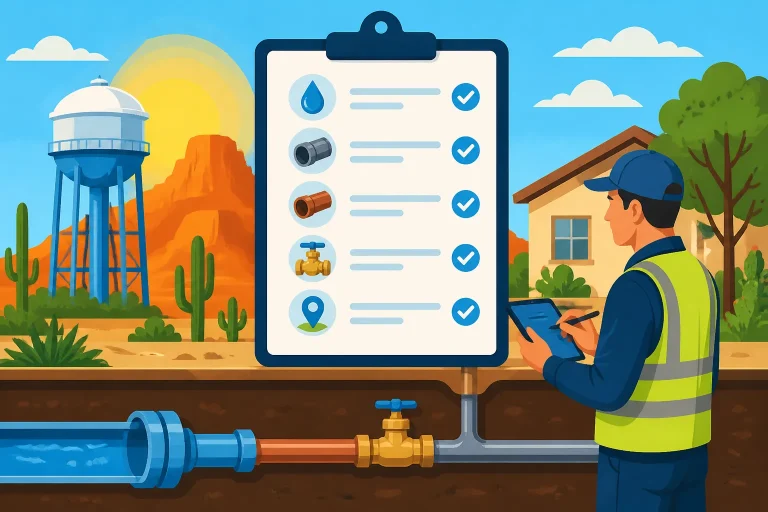
- Identify the water arrangement. Confirm whether the home uses a public system, private company, individual well, shared well, or hauled water.
- Verify the provider or system. Match the service address to the correct provider, system, and service area.
- Confirm service status. Ask whether the connection is active, whether a meter is installed, and whether any connection steps remain.
- Request billing records. Review a full seasonal cycle if possible, separating water use, fixed charges, sewer charges, and other fees.
- Get the current rate schedule. Ask how usage is measured, whether rates vary by tier or season, and how sewer charges are calculated.
- Check supply and drought information. Review the provider’s current supply, drought and conservation plans, plus customer notices and restrictions.
- For a development, verify the applicable determination. Ask for the relevant water-supply documentation and confirm it applies to the specific lot.
- For a well, inspect and test separately. Obtain records, arrange professional inspection, and order appropriate lab testing; do not confuse water quality with well capacity.
- For a shared well, review the recorded agreement. Understand maintenance duties, access rights, cost sharing, dispute processes, and emergency decisions.
- Inspect water-using equipment. Include irrigation, pools, storage tanks, treatment units, pumps and plumbing in the property review.
- Ask about planned expenses. Check for known repairs, provider projects, rate proposals, equipment replacement, or landscape changes.
- Confirm unresolved questions with official sources. Use the provider, city, county or relevant state agency’s official website for current records and contact details.
The goal is not to predict every future rate change or drought response. It is to understand what serves the house today, what obligations come with that setup, and which costs could fall on the owner. A provider’s official records and a qualified inspection are more useful than a broad claim that a neighborhood is “water secure.”
Frequently Asked Questions
Does drought mean an Arizona home could lose tap water?
Not automatically. Drought affects water sources and planning differently across providers and locations. Check the property’s actual provider, supply plans, drought measures, and service status rather than drawing a conclusion from statewide conditions alone.
Are water costs lower for a home with a private well?
Not necessarily. A well may avoid a monthly city water bill, but the owner is responsible for testing, electricity, repairs, equipment and any treatment. A shared well also has cost-sharing obligations, while hauled water requires delivery and storage.
Can a seller’s water bill predict what I will pay?
It can provide useful evidence, but it is not a reliable forecast by itself. Occupancy, season, leaks, irrigation, rate changes and sewer billing methods can all affect the total. Compare billing history with the provider’s current rate schedule.
What is the most important water document to request?
There is no single document for every property. Public-system buyers should confirm the provider and review its rates, supply information and water quality report. Well buyers should request well records, current test results, inspection findings, and any shared-well agreement.
Disclaimer
This article is for general informational purposes only and does not constitute professional advice. Laws, prices and regulations vary by location and change over time. Consult a qualified professional for guidance on your specific situation. Arizona Water Hub is not a government agency or water utility and is not affiliated with any public water system.