How to Look Up the Service Line Material at Your Arizona Address
An address search can show a service line marked lead, another material or unknown—and it may not tell you what is inside the house. Here’s how to find the record for your Arizona water provider, understand what it covers and follow up when the result is missing or unclear.
What a service line record tells you
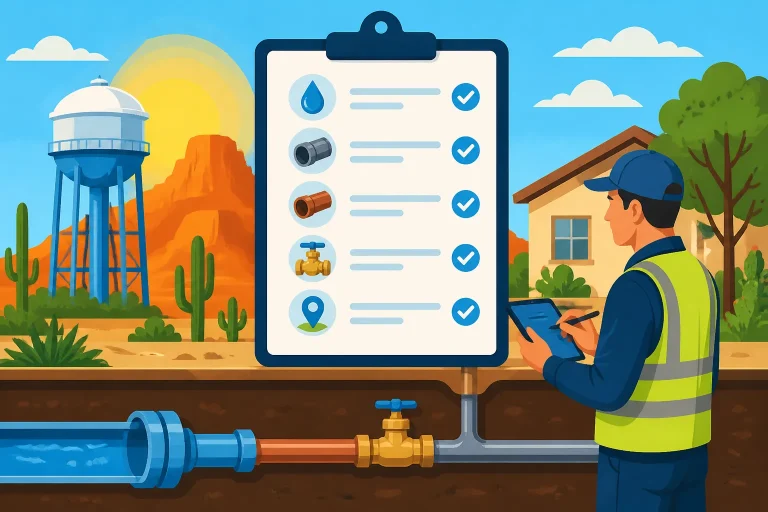
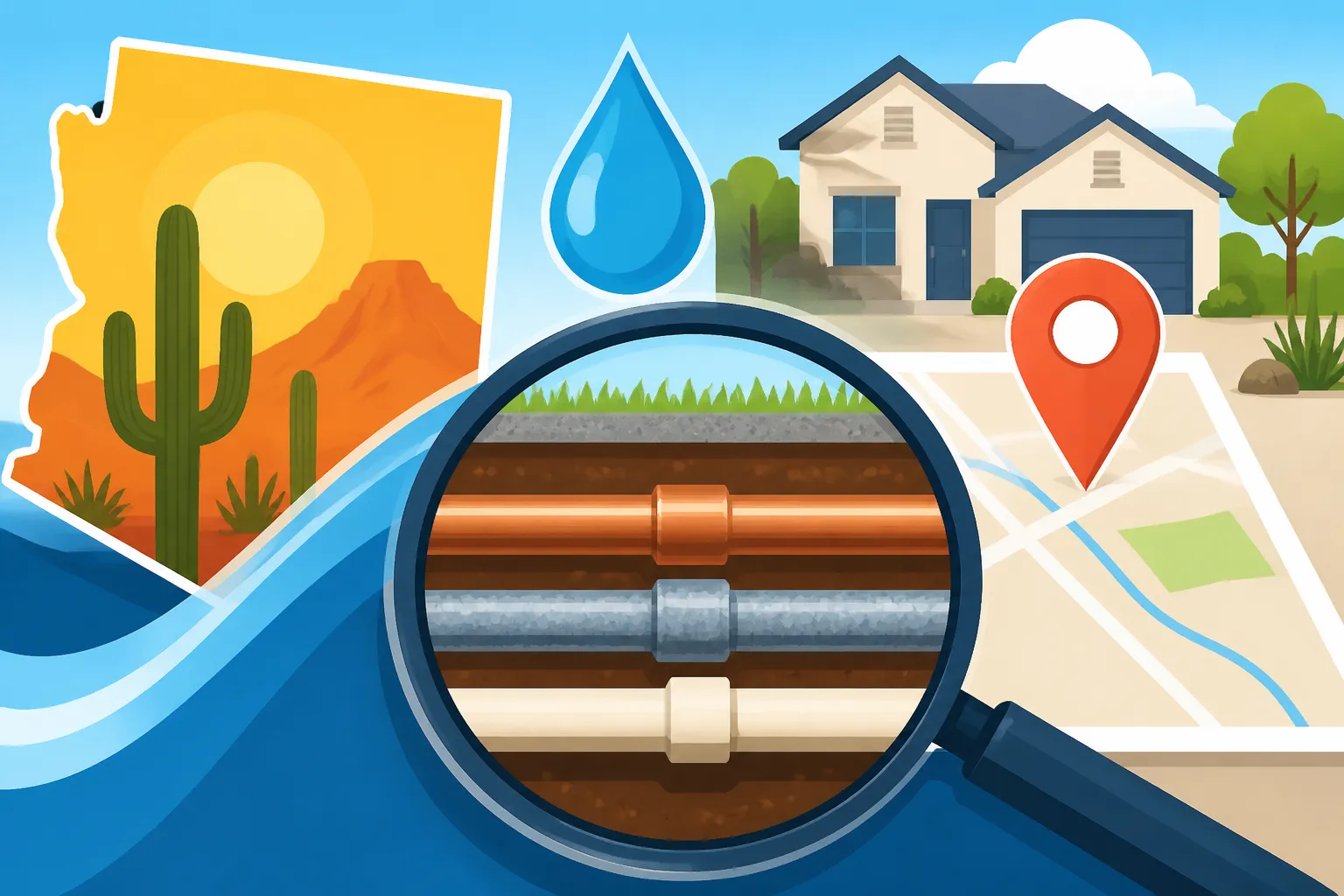
A service line is the pipe that connects a water main in the street to a building. It is different from the pipes and fixtures inside the building, such as the plumbing under a sink or the pipe supplying a refrigerator. The water meter is another useful reference point: it can help identify where the utility’s records end and where a customer’s plumbing begins, but responsibilities and record details vary by provider.
An inventory is a record of the materials a water provider has identified for service lines. It may describe the utility-owned section, the customer-owned section or both. A result for one side does not automatically tell you what material is on the other side, and an inventory is not necessarily a complete record of every pipe inside a home.
The distinction matters because a service line can be only one possible source of lead in drinking water. Plumbing inside the home, fixtures and other components can also affect water at a tap. A line marked as a material other than lead does not establish the material of indoor plumbing or confirm a particular tap’s water quality. For more on the boundaries of these records, see Service Line vs. Indoor Plumbing: What an Arizona Inventory Covers.
Your water provider is the place to start. The provider may be a city, a water district or a private company, and the correct inventory is the one associated with the system that serves your address—not necessarily the nearest city or the name you use for the neighborhood. If you are unsure which provider serves your home, Who Supplies Your Arizona Home’s Water? Find Out Before Testing can help you identify where to direct your question.
The City of Mesa says water providers must inventory water service line materials and make the information public as of October 16, 2024. The City of Phoenix Water Services Department says its service line inventory can be accessed through the City’s service-line inventory page. Those examples show why it is worth checking the provider’s own website rather than relying on an old notice, a real estate listing or a map for another community.
Find the inventory for your water provider
Start with the water provider named on your bill or account information. If you rent, ask the property manager which water provider serves the building, or check the utility information provided for the property. A landlord’s name, a neighborhood name or a city mailing address may not, by itself, identify the water system responsible for the service line record.
Once you know the provider, use its official website. Search the site for terms such as “service line inventory,” “service line material,” “lead service line” or “pipe material.” If the site has a search function, try the street address and those terms separately. Look for a page or tool that is clearly published by the water provider, not a commercial map or a general search result that may refer to another system.
The provider may present records in different ways. An address lookup might return a material classification, a map might show an area or service connection, or a page might explain how to request the result. Do not assume that every provider uses the same map, labels or search process. If the site offers no address search, that does not establish that your line is lead or that the provider has no inventory. Contact the provider through its official website and ask how to obtain the service-line material record for your exact service address.
For Phoenix customers, the City of Phoenix Water Services Department says the City’s service line inventory can be accessed at its service-line inventory page. Search the City’s official website for that inventory rather than using a third-party page. If the address does not appear, the result is hard to interpret or the page does not make clear which portion of the line is shown, ask Water Services to explain what its record covers.
A helpful way to approach the search is:
- Confirm the full service address, including the unit number if there is one.
- Identify the water provider that serves that address.
- Search the provider’s official website for its service-line inventory or material lookup.
- Enter the address as it appears on the water account, and try a standard street abbreviation if the tool does not recognize it.
- Save or note the result, including any explanation of which pipe section the result refers to.
- If the address is missing or the record is unclear, contact the provider and request an address-specific explanation.
Address tools can be sensitive to formatting. A house number, street suffix, apartment or building identifier may be entered differently across an account, a map and a property record. If a search returns no match, check for a spelling or formatting difference before concluding that no inventory record exists. If a search still fails, give the provider the exact service address and ask whether it has a record under a different format or account identifier.
Be alert to similarly named places and providers. A search for a city name may surface more than one water system, and a nearby provider’s inventory may not apply to your property. When in doubt, confirm the provider using your account information and ask it to verify that the result corresponds to the service connection at your address.
Read the result carefully
A material record is useful, but it answers a limited question: what material the provider has recorded for the service line or line section described. It does not necessarily tell you how the provider identified that material, whether the entire connection was visible during an inspection or whether indoor plumbing has the same material. If the result shows more than one section, read the labels for each section separately.
A record may use a named material, or it may indicate that the material is unknown or has not been confirmed. An unknown entry is not the same as a confirmed lead line. It means the record does not establish the material. Likewise, a material listed for one side of a meter should not be treated as an answer for the other side unless the provider’s explanation says that it covers both.
The City of Tucson says Tucson Water’s service-line inventory records materials on both sides of the water meter. That description is specific to Tucson Water’s inventory; do not assume another provider’s record has the same scope. If you are in Tucson and want to understand what an entry means, What an Unknown Service Line Notice From Tucson Water Means offers related context. For any provider, ask whether the displayed material applies to the utility side, the customer side or both.
If the inventory provides a map, check that the address marker is actually on your property or service connection. A map pin near a parcel boundary may be difficult to interpret, and a line shown along a street may not indicate which building or service connection it serves. Do not infer a material from the color of a line or a nearby marker unless the provider explains the map legend and confirms the record belongs to your address.
A useful result should let you distinguish among the address, the recorded material and the part of the service connection being described. If any of those pieces is missing, ask the provider to clarify before drawing a conclusion. Keep a copy of the result or note when you checked it, so you can compare it with a later response from the provider.
| What the record says | What you can reasonably take from it | What it does not establish by itself |
|---|---|---|
| A specific material is listed for a service-line section | The provider has recorded that material for the section identified | The material of every pipe, fixture or tap inside the building |
| Different materials are listed for different sections | The inventory distinguishes sections of the service line | That one section’s material applies to the other section |
| The result says unknown or unconfirmed | The provider has not confirmed the material in the record shown | That the line is lead, or that it is not lead |
| No address result appears | The search did not return a usable record | That no record exists, or that the service line is a particular material |
| The map shows a nearby marker or line | The map displays information near the address | That the marker belongs to your exact service connection |
A utility inventory and a water-quality report answer different questions. The inventory concerns service-line materials; a Consumer Confidence Report summarizes information about a public water system’s drinking water. Neither document necessarily describes the water at one particular household tap. For help finding the report for the system serving your home, see Which Utility’s Water Quality Report Covers Your Arizona Address?. For the limits of what a report can say about an individual home, see What an Arizona Water Quality Report Can and Can’t Say About Your Home.
What to do if your address is missing or marked unknown
First, make sure you searched the right provider’s inventory and used the service address rather than a mailing address if they differ. Check the unit or building identifier and try the address formatting used on the water account. If the search still does not produce a clear match, contact the provider through its official website. Include the full service address and describe what happened: no result, an unclear map, conflicting materials or a status marked unknown.
Ask direct, specific questions rather than asking only whether the home “has lead pipes.” For example:
- Does the record apply to the service connection at this exact address?
- Which part of the service line does the listed material describe?
- Is the material confirmed, or is it recorded as unknown?
- What information or inspection supports the classification?
- Is there a process to request verification or an updated record?
- Does the provider have separate information about the pipe on the customer side of the meter?
These questions help separate a search problem from a record that genuinely lacks a confirmed material. They also give the provider a chance to explain its terminology. If the provider gives a verbal answer, ask where the explanation or record can be found in writing.
If the provider confirms that the service line is unknown, ask what it recommends as the next step for that address. Do not treat a neighbor’s result as proof about your own line: nearby properties can have different service connections or records. Similarly, a home’s age alone does not confirm a material. The provider’s address-specific record and any further verification it describes are more useful than a guess based on a neighborhood or a building’s appearance.
For questions about pipe ownership or who handles work on each section, ask the provider to explain its responsibilities and the customer’s responsibilities for the address. Those boundaries can depend on the location and provider. Who Owns the Pipe? Meter, Service Line and Homeowner Duties in Arizona covers the distinction between the meter, service line and a property’s plumbing.
A service-line inventory is not a substitute for testing water from a household tap. If you want to know whether lead is present in water at a particular faucet, an address inventory cannot answer that by itself. You can ask the provider what testing information or options it offers and consider a suitable test for the concern. Finding a Certified Lab to Test Arizona Tap Water for Lead explains how to approach lab testing, while Should You Test for Lead When Your Arizona Line Material Is Unknown? discusses why an unknown line record and a tap-water test are separate questions.
If you are worried about a possible health effect, contact your local health department or a medical professional. For a water-quality concern, ask the provider or an appropriate local health authority what steps fit your circumstances. Avoid assuming that a particular result or product resolves a health question.
What Arizona city examples show
The inventory requirement does not mean that every provider presents information in the same way. The City of Mesa says providers must inventory water service line materials and make that information public as of October 16, 2024. The City of Phoenix Water Services Department says customers can access the City’s service line inventory through its inventory page. These examples make the practical point: start with the provider responsible for your address, then follow its own instructions for locating and interpreting the record.
For Tucson Water, the City of Tucson says its inventory records materials on both sides of the water meter. That is useful when checking whether a result describes only one section or both. Still, the scope of a record should be confirmed with the relevant provider, especially if a page shows several materials or the wording is unclear.
If a provider’s website does not make the inventory easy to locate, use its official site to find current contact details and ask for the inventory or an address-specific result. Do not rely on a search snippet, a third-party map or a document for another city as confirmation. A provider can tell you whether the record you found is current for its system and whether it matches the service connection at your home.
Keep the lookup in context. A material label is one piece of information about the service line, not a full inspection of the home’s plumbing and not a test of the water at the tap. If the record is unknown, ask what verification is available. If a material is listed, confirm which pipe section it refers to. If your concern is water quality rather than pipe identification, use a water-quality testing route as well as the inventory.
Frequently Asked Questions
Does an unknown result mean my service line is lead?
No. Unknown means the record does not confirm the material. Ask the water provider what the status means for your exact address and whether it offers a way to verify the line.
Does a service-line inventory describe every pipe in my home?
Not necessarily. An inventory concerns service-line materials, and the record may cover only a particular section. Ask the provider what its entry includes. Indoor plumbing and fixtures are separate considerations.
Can my neighbor’s result tell me what my line is made of?
No. A nearby property may have a different service connection or a different record. Check the inventory for your own address and ask the provider to confirm the result.
Does a material record show whether my tap water contains lead?
No. A service-line inventory identifies recorded pipe materials; it is not a test of water from a household faucet. If you need a result for water at a tap, ask about appropriate testing.
Sources
- City of Mesa — Lead and Copper – City of Mesa (checked November 13, 2026)
- City of Chandler — City Of Chandler 2025 Drinking Water Quality Consumer Confidence Report (PDF) (checked November 13, 2026)
- City of Scottsdale — 2026 Water Quality Report (PDF) (checked November 13, 2026)
- City of Glendale, Arizona — 2025 Water Quality Report WEB R1 (PDF) (checked November 13, 2026)
- City of Tempe (checked June 8, 2026)
- City of Tucson — Service Line Inventory City of Tucson (checked November 13, 2026)
Disclaimer
This article is for general informational purposes only and does not constitute professional advice. Laws, prices and regulations vary by location and change over time. Consult a qualified professional for guidance on your specific situation. Arizona Water Hub is not a government agency or water utility and is not affiliated with any public water system.