CAP, SRP, Groundwater or a Blend: Where Arizona Tap Water Comes From
Arizona tap water does not come from one statewide source. Depending on where you live, it may begin as Colorado River water delivered through the Central Arizona Project, Salt and Verde river water associated with the Salt River Project, groundwater, or a combination. The useful question is not just where water comes from, but how your provider treats, blends and reports it.
The main sources behind Arizona tap water
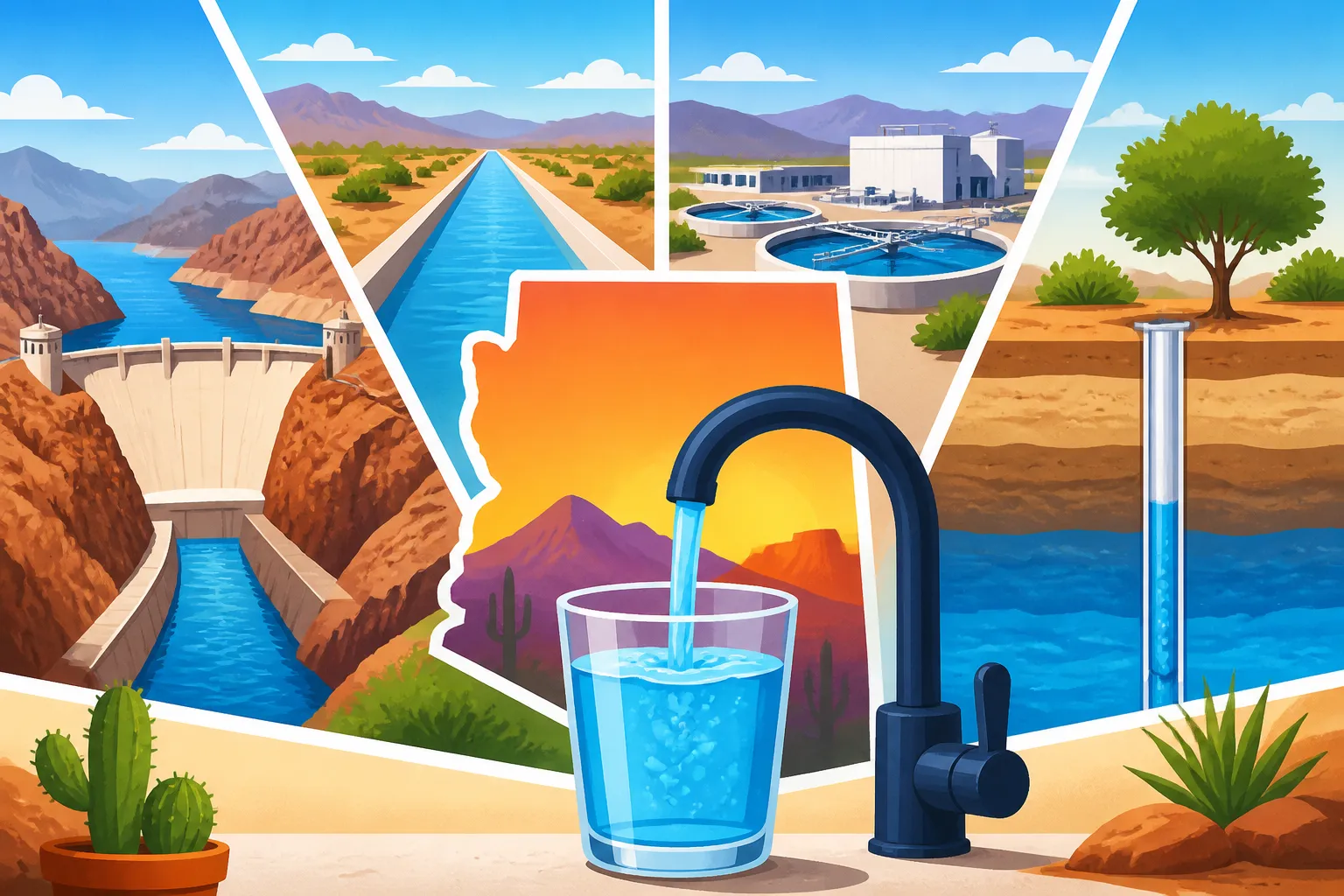
A water source is the place water originates before it is treated and delivered. For Arizona communities, the broad categories are surface water, groundwater and, in some places, a blend of both. The particular mix depends on a provider’s infrastructure, available supplies and operating choices.
Surface water comes from rivers, reservoirs and other water bodies. In central Arizona discussions, the Colorado River is commonly associated with the Central Arizona Project, or CAP, while Salt and Verde river supplies are associated with the Salt River Project, or SRP. These are separate water-supply routes, not interchangeable names for the water that comes from every tap. A utility may use one source, several sources, or water from different sources at different times.
Groundwater is pumped from underground aquifers through wells. It can be treated at a groundwater facility before entering a distribution system. Some communities use groundwater as one part of a wider supply; others depend on wells for a larger share. A provider may also recharge water underground and recover it later, so the source history can involve both surface water and groundwater infrastructure.
“Recharged water” can be confusing because the phrase describes a step in how water is managed, not necessarily the original source. Water placed underground for storage may later be recovered through wells. To understand what a utility means by recovered or recharged water, check the wording in that provider’s water quality report or source description. A label alone may not tell you whether the water began as Colorado River water, another surface-water supply, or a different source.
These categories are a starting point, not a guarantee about what is in the pipes at a particular home. Water can be treated, stored, blended and routed before it reaches a neighborhood. A city’s overall source profile may therefore differ from the mix reaching a particular treatment plant or pressure zone.
For more background on the supply systems, see CAP, SRP, Groundwater or a Blend: Where Arizona Tap Water Comes From—but for this article’s purpose, the key is to connect those source names to your own water provider and its report. If you are still not sure which utility serves your address, Who Supplies Your Arizona Home’s Water? Find Out Before Testing offers a practical starting point.
CAP and SRP are supply routes, not labels for every tap
CAP and SRP are often mentioned as if every Arizona household receives water from one or the other. That shortcut can leave out groundwater, local treatment arrangements and blended supplies. A provider’s supply choices depend on its own system, and neighboring communities can have different source portfolios.
CAP is associated with Colorado River water delivered to central Arizona. SRP is associated with water from the Salt and Verde river system. Those broad connections help explain why a city may report river supplies, but they do not by themselves reveal what proportion of a household’s water comes from each source. A city may use more than one source, and a source can enter the system through different treatment and storage processes.
The name of a source also does not tell you whether water is treated at a particular plant or routed to a particular part of town. A utility may have multiple treatment facilities, wells and service areas. Its supply can be managed as a system rather than as a fixed source assigned permanently to each home.
A report might name Colorado River water and Salt and Verde river water among a city’s sources without saying that every resident receives the same combination. It may also report a citywide share or annual total. Read those statements as descriptions of the utility’s supply, not necessarily a precise recipe for water at one faucet.
This is why source maps, city reports and general descriptions can appear to disagree. A map may show where a source can be used; a report may describe the supplies used over a reporting period; and a treatment plant page may explain the role of one facility. Each answers a different question. If you want the source mix for your neighborhood, ask the provider whether it publishes zone-level information or can explain which facilities serve your address.
When reading about changes in Colorado River supply, separate a regional supply issue from the day-to-day question of what water reaches your tap. Drought, River Shortages and the Water at Your Arizona Tap explains why a shift in available river supplies does not automatically mean that a community has no other water source. For a closer look at how cities may use multiple supplies, see If CAP Deliveries Are Cut, What Else Can Arizona Cities Draw On?.
How treatment and blending shape the water at home
Water generally passes through a series of utility operations before it reaches a home. The route may include a treatment plant, storage, pumping and distribution pipes. Groundwater may be treated at a well facility; surface water may go through a treatment plant; and supplies from different origins may be combined at some stage in the system. The exact arrangement is specific to the utility.
Blending means combining water from different sources or treatment paths. Providers may blend supplies to manage available water, operate their systems and deliver water that meets applicable requirements. A blend is not necessarily consistent across every neighborhood or season. The system may change which sources it uses as conditions and operating needs change.
The distinction between source and treatment matters. Two supplies can have different mineral content or taste characteristics before treatment, while treatment can change some aspects of the water. Distribution conditions can also influence what a customer notices. A source name alone cannot explain every taste, odor, color or residue at a faucet.
A city may report its sources at a broad level, while a local facility treats a particular supply. In that case, the plant’s role is part of the story but not the whole story: water may be stored, blended or moved before delivery. Similarly, a well’s location does not mean that only nearby homes receive its water.
For a household, these details are most useful when investigating a specific question:
- Concerned about source: Find the provider’s source description and ask whether it is citywide or specific to your service area.
- Noticing a taste or odor change: Ask whether the provider has information about recent operating or source changes, and compare the issue with Taste, Odor and Color Problems in Arizona Tap Water: An Overview.
- Trying to interpret a report: Check whether the data describe a treatment plant, a distribution area or the entire system.
- Considering a filter: Start with a test result or a clearly defined concern rather than assuming that a particular source requires treatment. Matching a Water Filter to One Concern: A Guide for Arizona City Water explains how to connect a treatment choice to the issue you are trying to address.
A source shift can sometimes be noticeable, but taste is not a reliable way to identify a source or judge safety. A mineral taste, chlorine odor or change in appearance does not on its own establish what caused it. If a change is sudden, persistent or accompanied by a utility notice, check the provider’s current information and follow its instructions. For a taste change that seems limited to one fixture, Odd Taste at Just One Faucet? Plumbing, Fixture or the Water Supply can help separate a possible plumbing issue from a wider supply change.
What city examples show about source differences
Arizona cities do not all describe their supplies in the same way. Some report multiple source categories; others describe a particular annual delivery mix or highlight a treatment facility. The examples below show why a statewide assumption is unreliable. They are descriptions of the named providers’ supplies, not a claim that the same mix reaches every home in each city.
| Provider | What the provider reports | What the detail helps explain |
|---|---|---|
| Phoenix | The City of Phoenix Water Services Department reports that About 98% of Phoenix’s water supply is surface water. In its 2025 report, the department says the primary sources of untreated surface water are the Salt, Verde and Colorado rivers. | Phoenix’s supply is predominantly surface water at the citywide level, but that does not establish the exact blend at every address. |
| Chandler | The City of Chandler says its drinking water comes from three sources. The Santan Vista Water Treatment Plant can treat and distribute 48 million gallons of Colorado River water daily. | The city identifies multiple sources and a specific facility for Colorado River water; the available fact does not name all three sources. |
| Mesa | In its 2025 report, the City of Mesa identifies the Colorado River, the Salt and Verde Rivers, and groundwater as its three primary water sources. | Mesa’s source description includes river water and groundwater, showing why “river water or well water” can be a false choice. |
| Tucson | The City of Tucson says its annual delivery was approximately 78% direct recovered recharged water and 22% Central Well Field water. | The reported annual delivery separates recovered recharged water from Central Well Field water, but it is not a guarantee of one fixed mix at every tap. |
| Scottsdale | The City of Scottsdale reports 21 active wells and operates groundwater treatment facilities, including facilities treating groundwater from the North Indian Bend Wash Superfund site. | Scottsdale’s wells and treatment facilities are part of its water-supply system; facility-specific information may be relevant to understanding a local supply area. |
The Phoenix figures describe the citywide supply and the sources of untreated surface water, not the proportion of each river’s water in every neighborhood. Chandler’s statement that its drinking water comes from three sources does not, by itself, identify the complete source list or each source’s share. For those details, read the city’s own source information rather than inferring them from a treatment plant’s capacity.
Mesa’s description makes the combination especially clear: its listed primary sources include the Colorado River, Salt and Verde Rivers, and groundwater. A household in Mesa should not assume that its supply is exclusively river water or exclusively groundwater simply because one source is more familiar.
Tucson’s reported annual delivery mix uses “direct recovered recharged water” as one category and Central Well Field water as another. Those labels are specific to the city’s reporting. They should not be treated as a universal description of how every Arizona provider accounts for stored or recovered water.
Scottsdale’s example also shows why groundwater information can be more detailed than a count of wells. Treatment facilities may serve particular sources or areas, and a named facility may have a special role in treating groundwater. The presence of a facility associated with a known site does not, by itself, tell you whether a particular home receives water from it or what the water quality is at that home.
For the current information that applies to your service area, use the provider’s official water quality report and source information. Which Utility’s Water Quality Report Covers Your Arizona Address? can help you identify the report to start with. If you are looking for the citywide report rather than a neighborhood explanation, Consumer Confidence Reports in Arizona: Finding and Reading Yours explains what these reports are designed to show.
How to find the source information for your address
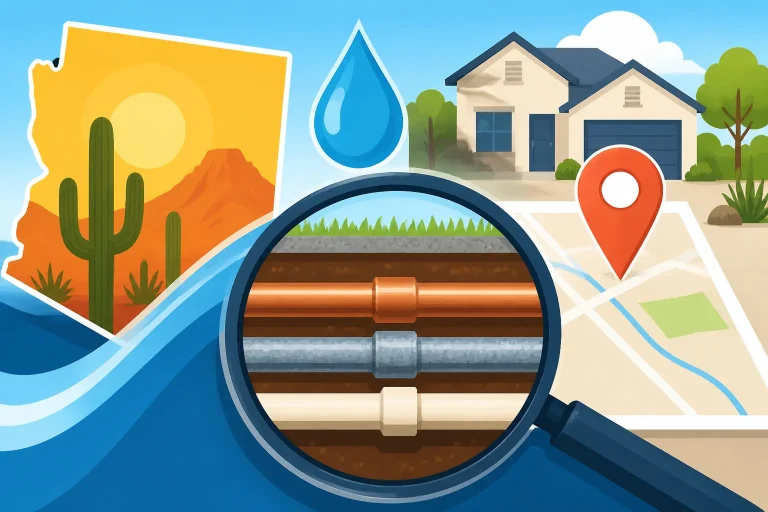
Start by confirming who provides your drinking water. City boundaries and utility service boundaries are not always the same, and a home near a city may be served by a different provider. Renters can ask the property manager or landlord which utility bills the property, then verify the provider through the official utility website.
Once you know the provider, look for its annual water quality report, source-water page, treatment plant descriptions and service-area information. The annual report may be called a Consumer Confidence Report. Some providers publish a broad citywide summary; others provide maps or explanations by area. If the available material does not identify the source mix for your address, contact the provider using its official website and ask a focused question.
A useful request is specific: “Which supply sources and treatment facilities may serve my address or pressure zone?” You can also ask whether the report’s percentages or annual delivery figures apply systemwide, to a particular treatment plant, or to a particular part of town. If the utility cannot provide an address-level breakdown, a citywide report can still help, as long as you understand its limits.
Use this sequence to avoid mixing up different kinds of information:
- Identify the water provider. Do not rely on the city name alone. Confirm the utility that supplies the property.
- Find the relevant report. Check that it applies to your provider and the period it covers.
- Locate the source description. Look for named rivers, wells, groundwater, recovered water or other source terms.
- Check the scale of the information. Notice whether the report describes the whole system, a facility, an annual delivery mix or a service area.
- Ask about your area if needed. Request an explanation for your address or neighborhood and ask whether source use changes across the service area.
A report is not necessarily a map of individual pipes or a guarantee of the precise water blend at a home. It is a provider-level resource, and its measurements may describe water at points in the system rather than water sampled from every household tap. For the difference between systemwide monitoring and what a home test can show, see What an Arizona Water Quality Report Can and Can’t Say About Your Home.
If the report names a source you do not recognize, first check how the provider defines it. “Groundwater,” “recovered water” and “surface water” may be presented as categories in a local accounting system. Ask the utility what the label means in its report instead of assuming that terms used by another city apply in the same way.
What a source report can and cannot tell you
A source description is valuable for understanding where a utility’s supply originates. It can help explain why a provider uses certain treatment plants, why its system includes wells, or why its supply may be described as a blend. It can also help put a local supply change in context.
But source information is not a complete picture of water quality at a kitchen faucet. A river, reservoir or aquifer is not the same thing as treated drinking water. The utility treats and monitors water through its system, and a report’s results need to be read with attention to where samples were collected and what the reported measurements represent.
A citywide source percentage also does not necessarily tell you the mix at an individual home. A reported annual share can summarize supply over a period, while actual operations and delivery routes can vary. A treatment plant’s capacity describes what the facility can handle, not the amount it necessarily treats at every moment or the water delivered to a specific block.
Likewise, a source label does not answer every concern about a home’s plumbing. Water can change as it travels through service lines, household pipes and fixtures. A city report can inform you about the public system, but it cannot establish the condition of every private pipe or faucet. If your concern is lead, the relevant question may involve the service line and interior plumbing as well as the utility’s supply. Does a City Water Report Describe Lead at Your Own Faucet in Arizona? explains that distinction.
For ordinary taste and mineral questions, source information is only one piece of the investigation. Hardness and dissolved mineral content can differ, and a water source name is not a substitute for the actual reported result. If scale, spots or soap performance are the concern, use hardness data rather than guessing from whether the supply is described as river water or groundwater. How Hard Is Arizona Water? Hardness, TDS and Mineral Content covers the difference between those measures.
If you are considering treatment, do not buy equipment simply because a report mentions a particular source. First identify the specific contaminant or quality issue, then compare the treatment device’s certification and reduction claim with the relevant test or report result. A filter designed to reduce chlorine taste, for example, is not necessarily designed to reduce a different contaminant. A softener addresses hardness-related concerns; it is not a general-purpose drinking-water filter.
If a report raises a health question, ask the local health department or a medical professional for guidance. A provider’s source description can explain supply origins, but it is not personal medical advice. For how to interpret an individual report result and its units, see Making Sense of Units and Limits on Arizona Water Test Results.
Source changes, alerts and practical next steps
Providers may adjust the sources they use as supplies and operating conditions change. A change in blend can sometimes coincide with a change in taste or odor, but that does not prove the source caused the change. Water may also taste different because of treatment operations, seasonal conditions or plumbing at the property.
If you notice a change, begin with the provider rather than trying to identify a river or well by taste. Check for current notices, service alerts or explanations on the official utility website. Ask whether the provider has reported a source or treatment change affecting your area. If the issue is limited to one tap, compare it with another faucet and consider whether a fixture or indoor plumbing could be involved.
If the utility reports no supply change, that does not automatically explain what you are noticing. Describe the problem clearly: when it began, whether it affects hot water or cold water, whether it occurs at one tap or several, and whether it is a taste, odor, color or visible residue. Those details can help the provider distinguish a broad distribution issue from a home-specific concern.
Follow any official water advisory or instruction without trying to infer the right response from the source type. A river supply, groundwater supply or blend does not determine whether an advisory applies. Check the notice and confirm whether your address is included. How Arizona Utilities Tell Customers About Drinking Water Problems explains where providers may communicate water-quality notices, while Boil-Water Advisories in Arizona: A Practical Guide for Households covers what to do when a boil-water advisory is issued.
For an ongoing taste concern, a report or source explanation may help narrow the possibilities, but taste alone cannot verify that water is safe or unsafe. If you want a household test, match the test to the question: a general test will not necessarily measure every contaminant, and a taste complaint does not reveal what analytes to request. Start with the provider’s report and ask a qualified laboratory or the local health department about appropriate testing when needed.
The most useful takeaway is simple: use statewide source terms to orient yourself, then move to your own provider’s information. CAP, SRP, groundwater and blends describe different parts of Arizona’s supply picture. Only the provider’s service-area information can clarify how those supplies relate to the water delivered to your address.
Frequently Asked Questions
Does every Arizona home get CAP water?
No. Providers have different source portfolios. Some use Colorado River water, some use Salt and Verde river supplies or groundwater, and some report a combination. Confirm the sources with the utility serving your address.
Does an annual source percentage tell me exactly what comes from my tap?
Not necessarily. A reported percentage may describe an annual or systemwide supply mix, not an address-specific blend. Ask the provider what area and period the figure covers.
Is groundwater untreated when a city pumps it?
Not necessarily. Providers may operate groundwater treatment facilities before delivering water. Check the utility’s treatment and source information for the specific system.
Can I identify my water source by its taste?
No. Taste is not a reliable way to identify a source or determine water quality. Ask the provider about source information and report a sudden or persistent change.
Does a water quality report describe the pipes inside my home?
Not fully. A provider’s report describes its system and sampling results; it does not inspect every household service line, pipe or fixture. Home plumbing may require a separate assessment or test.
Sources
- City of Phoenix Water Services Department — Water Services FAQs | City of Phoenix (checked November 13, 2026)
- City of Phoenix Water Services Department — Wsdprimarywqr (PDF) (checked November 13, 2026)
- City of Chandler — City Of Chandler 2025 Drinking Water Quality Consumer Confidence Report (PDF) (checked November 13, 2026)
- City of Mesa — English Water Quality Report 2025 (PDF) (checked November 13, 2026)
- City of Tucson — CCR Mainsystem 2025 (PDF) (checked November 13, 2026)
- City of Scottsdale — 2026 Water Quality Report (PDF) (checked November 13, 2026)
Disclaimer
This article is for general informational purposes only and does not constitute professional advice. Laws, prices and regulations vary by location and change over time. Consult a qualified professional for guidance on your specific situation. Arizona Water Hub is not a government agency or water utility and is not affiliated with any public water system.