What Arizona Water Systems Must Record in a Service Line Inventory
A service line inventory is a record of the pipe materials that connect a public water system to homes and other properties. If you have received a notice about an unknown or possibly lead line, the labels can be hard to interpret. Here’s what Arizona systems must inventory, what those categories mean, and what the record can—and cannot—tell you about your own plumbing.
What a service line inventory is meant to show
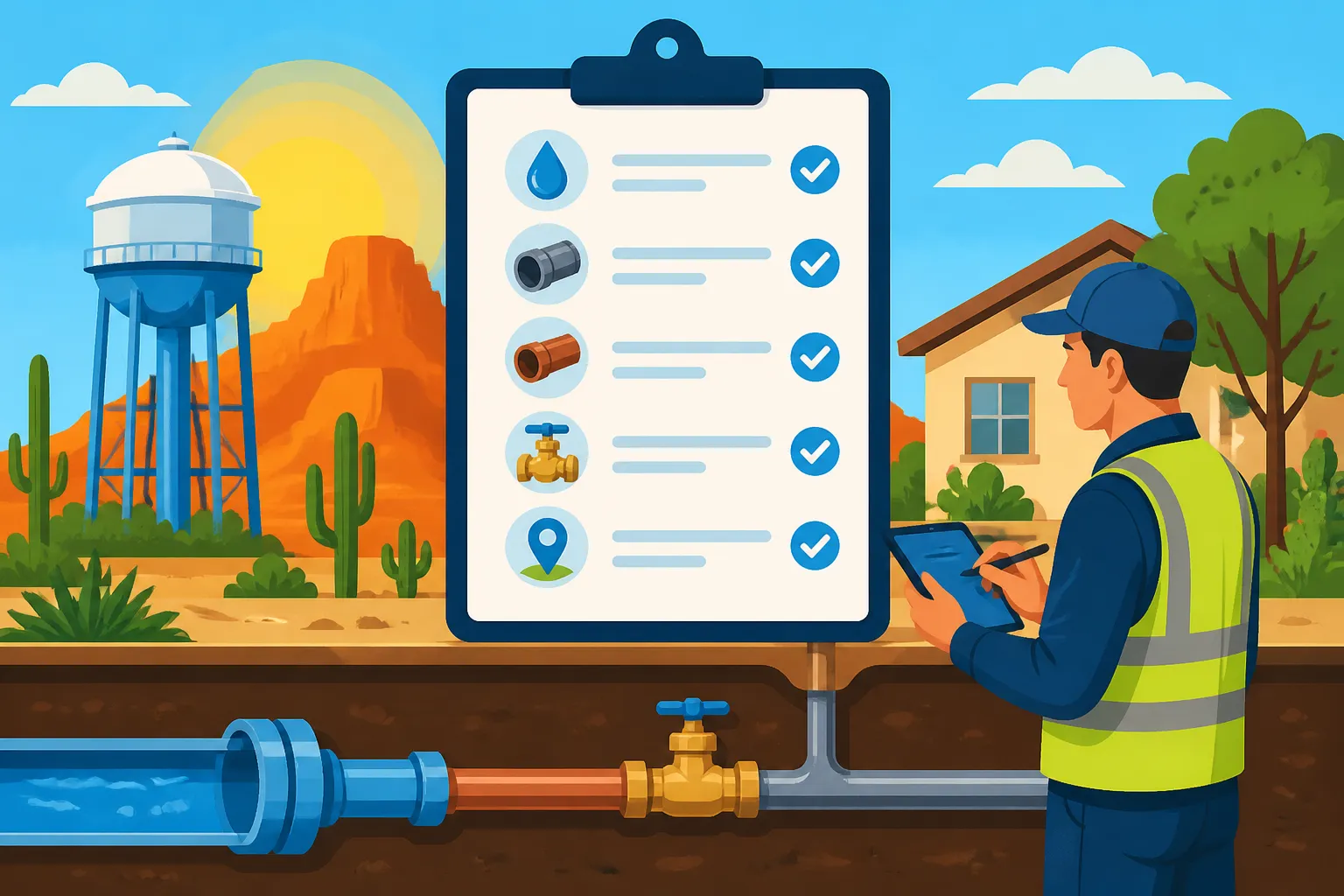
A service line is the connection between a water system’s distribution network and a building. The inventory tracks the material of the service line, rather than describing every pipe inside a home. That distinction matters: a system’s inventory may cover the utility-owned side, the customer-owned side, or both, depending on the records and how the local system documents its lines.
The inventory is intended to identify lines made of lead, certain galvanized pipe, other materials, or materials that have not yet been confirmed. It gives the water system and the public a record to use when assessing where further verification or action may be needed. It is not a water test at an individual kitchen tap, and a map or address lookup is not a complete inspection of a home’s interior plumbing.
The federal inventory requirement was introduced through the Lead and Copper Rule Revisions. The City of Chandler says the Lead and Copper Rule Revisions (LCRR) were introduced by the EPA in 2021 and require all utilities to conduct a service-line material inventory. The City of Mesa says water providers must inventory water service line materials and make the information public as of October 16, 2024. Chandler, Scottsdale, Glendale, and Tempe also describe public systems’ inventory and public-access requirements.
That shared deadline does not mean every system used the same records, inspection methods, or online format. An inventory is a working record assembled from available information; an entry may reflect a verified material, an older record, or an unresolved question. For background on the broader rules and what may happen after inventories are completed, see Arizona’s Lead Pipe Rules for Homeowners: Inventories to Replacement.
The inventory’s main practical value is that it can help answer a focused question: what material does the water provider currently have recorded for the service line at this address? It does not, by itself, answer whether water from a particular faucet contains lead, whether every pipe in the building is lead-free, or who will pay for work on a line. Those questions need their own records, testing, or discussion with the provider.
The four material categories and what they tell you
The City of Mesa describes four material categories: Lead, Galvanized, Other, and Unknown. The labels are useful, but they are not interchangeable. An entry is a record classification—not a full report on water quality at a tap.
| Inventory category | What the label indicates | What it does not establish on its own |
|---|---|---|
| Lead | The service line is identified as lead in the inventory. | Whether a particular tap has a particular lead result, or what the rest of the home’s plumbing contains. |
| Galvanized | The line is recorded as galvanized material. The system’s label and follow-up information matter for understanding whether further action is needed. | That every galvanized pipe is treated identically, or that the entry describes all indoor plumbing. |
| Other | The line is identified as a material other than lead or galvanized. | The exact material or condition unless the system’s record provides that detail. |
| Unknown | The system does not have enough confirmed information to identify the material. | That the line is lead, or that it is not lead. |
Lead
A Lead classification means the inventory identifies the service line as lead. That is a meaningful result for understanding the recorded line, but it is not a direct measurement of water from a household tap. Lead can also be associated with plumbing components within a building, so an inventory entry about a service line cannot describe every possible source in the home.
If your address is listed as Lead, read the provider’s explanation of what the entry covers and what steps it recommends. Ask whether the record refers to the utility side, the customer side, or the complete service line. If the provider has a process for confirming materials or discussing replacement, use its official website to find current instructions. For details about notice and replacement issues, see Who Gets a Notice About Lead, Galvanized or Unknown Lines in Arizona? and Lead or Galvanized Line Confirmed: Who Covers Replacement in Arizona?.
Galvanized
Galvanized is a material classification, not a synonym for lead. It is still important to read the provider’s own description because the inventory categories are designed to help systems distinguish lines requiring attention from lines recorded as other materials. The City of Phoenix, for example, says it prepared an inventory to determine if any of our service lines contain lead, galvanized pipe requiring removal, or unknown materials.
Do not infer from the word “galvanized” alone what a provider has concluded about a particular address. Check the inventory notes, its material definitions, and any address-specific notice. A general category may not communicate the reason a line was placed there or what verification has occurred.
Other
Other indicates that the system has classified the line as a material outside the Lead and Galvanized categories. It is a broad label: unless the provider’s map or records name a specific material, the category may not tell you whether the pipe is copper, plastic, or something else. Avoid filling in that missing detail by guessing from the home’s age or appearance.
The category also has a limited scope. A line recorded as Other does not mean that the whole building has been checked, or that fixtures, interior plumbing, solder, and other components have been assessed. If you are trying to understand the home’s full plumbing picture, Service Line vs. Indoor Plumbing: What an Arizona Inventory Covers explains why the boundary of the inventory matters.
Unknown
Unknown means the material has not been confirmed in the system’s record. It is not a finding that the line is lead; it is also not confirmation that it is made of a non-lead material. It signals a gap in available information.
The provider may have classified a line as Unknown because its records are incomplete or because the available evidence does not establish the material. Ask what the label means for your address, whether the system expects to seek more information, and whether there is a way to submit relevant documentation or request a field check. To understand the limits of an unknown label and what you can check on your property, see Galvanized or Unknown Line? Checking Your Side of the Meter in Arizona.
What the inventory records about each side of the meter
A service line can cross a property boundary and include different sections with different ownership or maintenance responsibilities. For that reason, a useful question is not just “What material is listed?” but also “Which part of the connection does this entry describe?”
Tucson Water’s inventory records materials on both sides of the water meter. That example is a reminder to check the scope of your own provider’s inventory rather than assuming that every Arizona map displays the same segments. Some records may show distinct entries for the utility side and the customer side; others may present information differently. Read the map legend and the provider’s explanatory notes.
The meter is a helpful reference point, but it does not automatically tell you who owns every pipe, who is responsible for repairs, or where the service line runs underground. Local rules, utility arrangements, and property-specific records can affect those answers. If ownership is unclear, Who Owns the Pipe? Meter, Service Line and Homeowner Duties in Arizona can help frame the questions to ask.
Read the address record as a limited snapshot
When looking up an address, check whether the entry has separate material labels for different portions of the line. If only one label appears, look for a note explaining whether it applies to the entire service line or just a segment. Also look for any indication that the material is confirmed, estimated, or still unknown. If the interface does not make that clear, ask the provider how to interpret the record.
An online map is a convenient way to see what the system has recorded, but it may not display the documents or evidence behind the classification. A mismatch between a map and an older notice is a reason to ask for clarification, not to assume one record is automatically correct. Keep a copy of the response and any records the provider gives you.
Inventory does not mean every pipe in a home was recorded
The inventory concerns service-line materials. It is not a room-by-room or fixture-by-fixture plumbing inspection. A home may have pipe sections, fittings, or other components that are not represented in the utility’s service-line record. The inventory also does not establish a water-quality result at your faucet.
For that reason, a “non-lead” or “Other” entry should not be read as a statement that every plumbing component in the building has been assessed. Likewise, an Unknown entry does not, by itself, settle what a household should do about drinking water. If you have a specific concern about lead at the tap, look into the provider’s testing advice and appropriate sampling options. Does a City Water Report Describe Lead at Your Own Faucet in Arizona? explains why system-level records and household tap results answer different questions.
How Arizona systems built and submitted their inventories
An inventory is assembled from information a water system can use to identify service-line materials. The public-facing record may reflect information gathered from existing records, direct checks, or other verification steps. The exact methods and evidence available can differ by system and address. The key is to understand what the provider says it used and how confident it is in the recorded classification.
Phoenix prepared a service line inventory to determine if any of our service lines contain lead, galvanized pipe requiring removal, or unknown materials. The City of Phoenix Water Services Department submitted its service line materials inventory to ADEQ in October 2024. That submission is a specific Phoenix record; it does not establish how another Arizona provider prepared its inventory.
For residents, this distinction makes the system’s documentation important. An inventory may be publicly available while still containing unknown entries or requiring later clarification. Public availability means customers can consult the record; it does not mean every address was physically inspected or that every classification has the same level of verification. Phoenix’s stated purpose and submission date give residents a starting point for asking how the city’s record applies to a particular property.
The City of Mesa’s category descriptions help readers understand the broad labels, while local systems may provide more detail about their own methods and records. When a map gives only a category, ask whether the provider can explain the supporting information or confirm which segment the category covers. If the classification changes after more information is reviewed, ask how the revised record will be reflected in the public inventory.
For practical help with locating a provider’s records, see How to Look Up the Service Line Material at Your Arizona Address. If you are trying to understand how a system may confirm pipe material in the field, Doorhangers, Crews and Records in an Arizona Service Line Inspection describes the types of details worth clarifying with the provider.
How to use the record for your address
Start with the public inventory for the water provider serving the property. If you are unsure which provider serves the address, check a recent water bill or use Which Utility’s Water Quality Report Covers Your Arizona Address? as a starting point. The inventory is provider-specific, so a nearby city’s map may not apply to your home.
Then read the entry with its notes and legend. Confirm that the address is correct, identify whether the map separates the line at the meter, and note the category assigned to each section. If an entry is Unknown, treat it as unresolved rather than as a confirmed material. If the address does not appear, ask the provider whether the inventory uses a different address format, whether the property is included, or how to request the record.
A focused question often gets a clearer answer than a general request for “the lead status.” You might ask:
- What service-line segments does this address record cover?
- Does the map distinguish the utility side from the customer side of the meter?
- What does the listed category mean under this provider’s definitions?
- Is the material confirmed, or is the entry based on incomplete information?
- Is there additional documentation or a process for checking the material?
- How can you get an updated copy if the record changes?
Keep any address-specific notice and provider response together with the inventory lookup. If a property is rented, a tenant can ask the landlord or property manager for plumbing information and can contact the water provider about its public records. The provider’s inventory describes the system’s service-line record; it does not replace a conversation about building plumbing or responsibility for repairs.
If the record lists Lead or Galvanized, avoid assuming that the label alone tells you what will happen next. Ask the provider what the classification means for that segment, whether additional confirmation is planned, and where to find current guidance. If the line is Unknown, ask what evidence could resolve the record and whether the provider has a process for addressing uncertain materials. For general information about line-material records and customer notices, see How Arizona Utilities Tell Customers About Drinking Water Problems.
If the question is about water at a faucet rather than the pipe material, treat it as a separate question. A service-line inventory does not show a household’s tap test result. Consult the provider’s current recommendations and, when appropriate, ask about testing through a qualified laboratory. For information on testing, see Finding a Certified Lab to Test Arizona Tap Water for Lead.
Common misreadings to avoid
The inventory is useful, but several common assumptions can make it seem more definitive than it is.
- Unknown does not mean lead. It means the material has not been confirmed in the record.
- Unknown does not mean lead-free. An unresolved classification should not be treated as a clean bill of health for that line.
- Other is not necessarily a specific material name. Look for a more detailed description if the category matters to your question.
- A service-line entry is not a complete home-plumbing inventory. It may not describe indoor pipes, fixtures, or other components.
- A material classification is not a tap-water test. The inventory and a household sample answer different questions.
- A map entry does not settle ownership or payment responsibility. Ask the provider and review property-specific information.
- Public access does not guarantee every record is equally detailed. The map may show a category without displaying all supporting information.
Reading the record this way helps keep it useful without asking it to answer questions it was not designed to answer. It can identify what the provider currently records for a service line and help direct a follow-up conversation. It cannot, by itself, establish every pipe material in a home or measure the water at a particular tap.
Frequently Asked Questions
Does an Unknown service-line entry mean my line contains lead?
No. Unknown means the provider has not confirmed the material in its record. Ask the provider what information is available and whether there is a way to verify the line.
Does an inventory tell me whether my tap water contains lead?
No. An inventory records service-line materials, while a water sample measures water from a particular sampling point. Use the provider’s guidance or a qualified laboratory for questions about testing.
Does the inventory include pipes inside my house?
Not necessarily. The inventory concerns the service line, and its coverage can vary by system. Check whether the record separates the line at the meter and ask what it excludes.
Why might an address have more than one material category?
Different portions of a service line may have different recorded materials. Check the map legend and ask the provider which segment each category describes.
Sources
- City of Phoenix Water Services Department — Water Services FAQs | City of Phoenix (checked November 13, 2026)
- City of Mesa — Lead and Copper – City of Mesa (checked November 13, 2026)
- City of Chandler — City Of Chandler 2025 Drinking Water Quality Consumer Confidence Report (PDF) (checked November 13, 2026)
- City of Scottsdale — 2026 Water Quality Report (PDF) (checked November 13, 2026)
- City of Glendale, Arizona — 2025 Water Quality Report WEB R1 (PDF) (checked November 13, 2026)
- City of Tempe (checked June 8, 2026)
- City of Tucson — Service Line Inventory City of Tucson (checked November 13, 2026)
Disclaimer
This article is for general informational purposes only and does not constitute professional advice. Laws, prices and regulations vary by location and change over time. Consult a qualified professional for guidance on your specific situation. Arizona Water Hub is not a government agency or water utility and is not affiliated with any public water system.